|
Metal
COOLING PICK OUTS IN MOLDS A low volume Plastic Injection Molder was having parts quality problems. The company was also having to "no quote” some parts too often due to their
inability to meet the exacting quality requirements of the medical industry.
As a low volume molder, the bottom line demanded that they use prototype
tooling to save approximately 50% on their tooling costs to enable them to be competitive. The prototype molds that the company used utilized "pick outs"
(core pins) to allow cooling of the parts in the mold. (Water cooling the molds, although more efficient, would have killed the jobs on price.)
Molds for long, thin parts were a real headache. The largest part measured only 2-1/2" x 10" x 1/8" thick. The
500F to 600F temperatures being developed in the molds caused the "pick outs" to turn blue. The high mold temperatures that turned the “pick outs” blue significantly shortened the life expectancy of the mold. During one
attempt to run Altemptm plastic parts, the mold core "died" after two days due to the extreme heat.
The ABS blend and "Altemp" plastic parts the molder was trying to run required internal mold core temperatures
no higher than 150F and 250F respectively. The high mold temperature did not permit the parts to cure out and caused the plastic to stick to the mold.
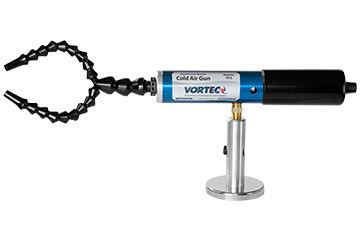
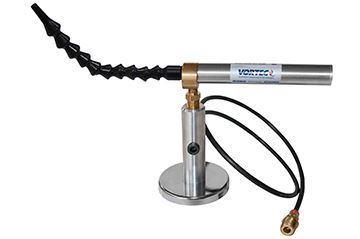
SOLUTION: At this point, the engineer decided to try using a 610 Adjustable Cold Air Gun. The Gun was being used in another department to provide cooling for a machining operation.
SUMMARY: The 610 running at only 50 PSIG provided an adequate supply of cooled air to the "pick outs" to
eliminate all heat-related mold problems and enabled the engineer to increase the line speed by 40 cycles per hour!
BLOWOFF IMPROVES QUALITY IN ROLL FORMING A Midwest manufacturer of fiber drums discovered that he had a residue problem on the lock band that secures the drum cover to the drum.
Lock bands are rolled "in house" at the rate of 15 per minute. During the
rolling process, the lock band is flooded with a water based lubricant that relies on luck to drain off the part. Luck runs out in one week when the
residue from the lubricant forms a coating of scum on the surface of the lock band, severely impairing the appearance of the product.
Initially, the problem was “solved” by building additional cost into their manufacturing process. They assigned 8
man hours to hand wipe every lock band immediately after the roll forming process.
SOLUTION: Shortly after being introduced to the 909 Transvector Set Jet, the Plant Engineer installed a Jet on
1 of his 4 Roll Forming machines to automatically blow off the lock bands.
SUMMARY: The 909 Transvector Set Jet paid for itself the first day on the job and allowed the Plant Engineer
to move the person wiping down the lock bands to the Handle Riveting.
A LITTLE EXTRA COMFORT MAKES A BIG DIFFERENCE
In industries where metals such as steel are being formed, high plant temperatures can become quite uncomfortable. It is not uncommon for
temperatures within a plant to reach over 1100F (38C) on a summer day.
SOLUTION: One major steel forging plant in particular responded to a
Vortec's Personal Air Conditioner display at the National Plant and
Engineering Maintenance trade show in the hopes of increasing worker comfort and productivity. Within a few weeks, several dozen PAC and 855
Diffuse Air Vests (many of which were in special sizes) were ordered.
SUMMARY: The workers love the vests, and because less recuperative
time is required throughout the day, productivity increased. One worker commented that he used to perspire profusely, but with the vest he no longer
perspires at all! Wearing the vests helps the worker remain alert and comfortable in the most uncomfortable environments.
Ideal in forging plants, smelters, foundries and steel mills, the Diffuse Air Vest with PAC is also well suited when
an over garment such as a welding jacket or coveralls must be worn.
QUIET YOUR METAL STAMPING OPERATION AND SAVE
MONEY An Ohio / West Virginia territory sales representative noticed a thunderous sound coming through the walls of a building in an area he was cold calling.
The sound was the rush of air from multiple open copper tubes being used as cycled blowoff on a series of metal stamping machines.
Coincidentally, the plant manager was on the hunt for a blowoff product that
would reduce the dangerously high sound levels, as well as save on compressed air. Each of the 6 stamping machines uses 6, and sometimes 8, 3/8" open copper tubes delivering a
nearly 1 second blast of 100 psig air, 30 times a minute, 24 hours a day, 5 days a week!
SOLUTION: He suggested the 1203 High Thrust nozzle as the solution to the noise and consumption problem.
SUMMARY: The results:
- - Sound level dropped from 107 dba to 91 dba.
- - Compressed air costs dropped from $325 to $80 per day.
- - Management Immediately initiated similar changes at branch locations.
- - Annual compressed air savings conservatively estimated at $61,000!
- - Everyone involved is thrilled with the change, the savings, and with Vortec!
This is a classic example of the potential for our product, as many plant managers are unaware of the potential
savings from a reduction in compressed air usage
PARTS EJECTION IN METAL STAMPING
Part ejection from molding machines or stamping presses is a common application for compressed air blowoff. Most plant engineering people are
adept at rigging creative blowoff devices using open or crimped pipe, but because production is the primary motivation, the expense and noise
associated with these types of crude blowoffs is a much lower priority, if noticed at all. Volumes of wasted air can add up to huge hidden production
expenses as well as an invitation for OSHA to come in and shut down the plant.
A stamping company in Ohio had fallen into this same scenario. Ejecting a 6 oz. bushing with 5 - 3/8”open copper
tubes at 75 PSIG each was certainly overkill. At 375 SCFM, this configuration also cranked out well over 100 dba.
SOLUTION: The solution went beyond simply replacing the 5 tubes with Vortex blowoff products as it was
found that just 1 - 1203 High Thrust Nozzle completely replaced the previous set-up. A 1203 High Thrust Nozzle at
75 PSIG consumes just 22 SCFM and the dba level is in the 80's.
SUMMARY: If we use the commonly assumed rate of $0.30 per 1000 cubic feet of compressed air, the cost to
operate 1 - 1203 nozzle is about $0.40 per hour vs $6.75 per hour for the previous set-up! What does this add up to in a 3-shift operation over a one year period?...
$6.75/hour x 24 (hours/day) x 250 (working days/year) = $40,500.00
$0.40/hour x 24 (hours/day) x 250 (working days/year) = $ 2,400.00
Savings realized: $38,100.00
BLOWOFF EXCESS PROCESS CHEMICALS IN PARTS CLEANING The rinse water from Parts Washers must be treated as contaminated wastewater once it has been used for parts cleaning. Contaminated rinse
water requires treatment (by an industrial waste handler) to remove harmful or regulated pollutants before the water is discharged.
The biggest source of contaminated rinse water is process chemical drag-out.
Drag-out occurs when process chemicals "ride out" on the surface of the part or are trapped in low areas of the part. By reducing drag-out, the rinse water
will be less contaminated and will last longer, reducing disposal costs.
SOLUTION: Curtain Transvectors (aluminum body), when positioned within 4 inches of the part surface, are able to strip off excess process chemicals to help keep rinse water clean. If the
customer prefers Stainless Steel Curtain Transvectors, they must be positioned within 2 inches of the part surface due to design differences.
SUMMARY: Using Curtain Transvectors to blow off excess process chemicals saves the customer money
three different ways: by reducing the amount of chemicals they must buy because they're keeping more of the
chemical in the tank; reducing the amount of money that is paid for disposal of contaminated wastewater; and
virtually eliminating the time necessary for clean up of spills and dripping contaminated water from parts (around the tank).
OTHER METAL APPLICATIONS Steel
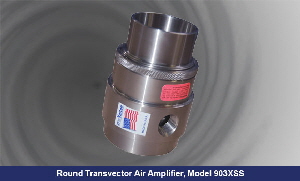
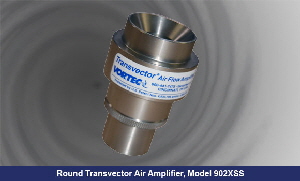
cable manufacturer strips water off a continuous, high speed 3/8” diameter rod line by running the cable through a 902 Transvector.
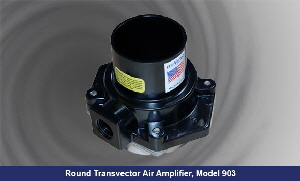
Metal converting service center uses a 903 Transvector to remove and carry the paper backing from 1”wide rolls of steel to a waste bin.
Manufacturer of cast metal parts uses a 921SS Stainless Steel Curtain Transvector to blow across the lens of a remote camera to keep dust and dirt floating in the air from settling on the glass.
Manufacturer of custom machinery uses a 308-35-H Vortex Tube to cool down shafts in order to fin a 2” bearing on the shaft.
|